01 / Research question
Rank single-point peptide mutations by their impact on protein binding.
02 / Innovation
Equal-weight rank fusion of energetic perturbation, geometric environment and evolutionary compatibility; calibrated residual variant reported separately.
03 / Mechanism
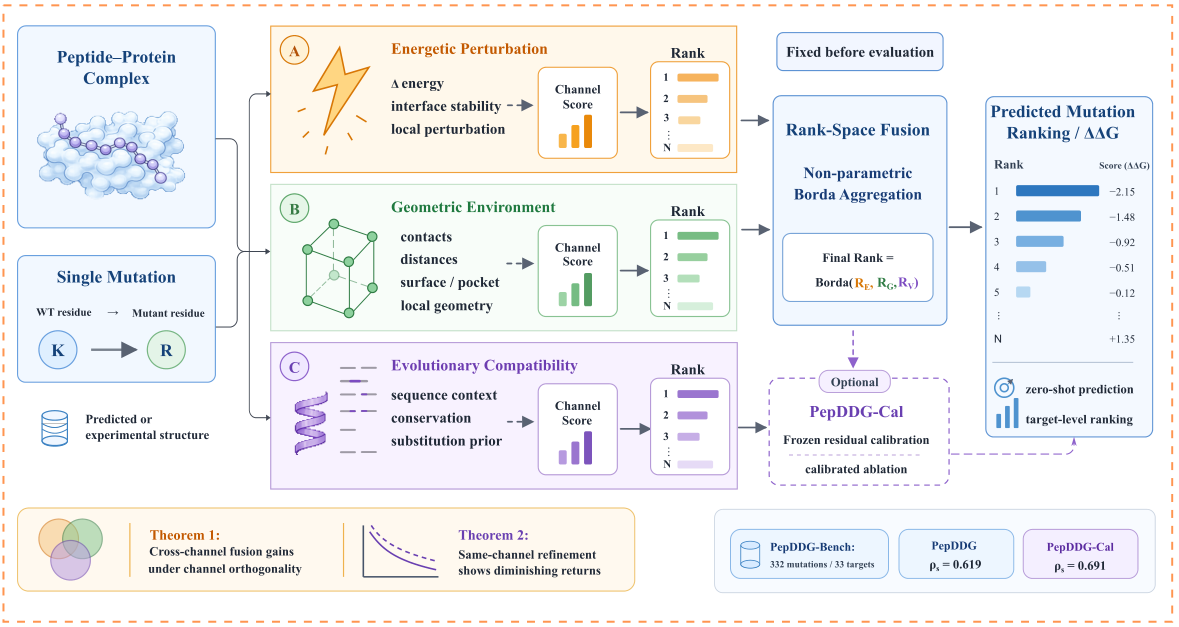
Energy, geometry and evolutionary compatibility signals are converted to ranks and combined with equal-weight Borda rank-sum. The core output orders single-point peptide-chain mutations; a separate residual-calibration variant must be distinguished from zero-shot ranking.
04 / Experimental setup
Author-provided V4: 332 peptide-chain single-point mutations across 33 targets with crystal structures.
Author-provided V4 · accepted NeurIPS 2026 · Source ↗
05 / Results
Pooled Spearman correlation: zero-shot PepDDG 0.619; separately calibrated PepDDG-Cal 0.691.
AUTHOR-AUTHORIZED V4 / ORIGINAL FIGURE 1
Three kinds of evidence. One ranking problem.
PepDDG transforms energetic perturbation, geometric environment and evolutionary compatibility into rank space, then combines them with equal-weight Borda rank-sum. Larger scores indicate more destabilizing mutations. Its output is an ordering, not calibrated kcal/mol predictions.
01 / Energetic perturbation
OpenMM with Amber ff14SB / OBC2; paired wild-type / mutant restarts construct binding-energy and interface-interaction proxies.
02 / Geometric environment
Wild-type interchain heavy-atom contacts (8 Å) and Cα neighbors (10 Å). Position-only: different substitutions at the same site receive the same geometric signal.
03 / Evolutionary compatibility
Pretrained ProteinMPNN complex / isolated-chain likelihood differences and mutation likelihood ratios. No task-specific fine-tuning; the pretrained model itself is learned.
Deployment ranks candidates within a target; the pooled benchmark ranks the full cohort. Training-free means no task-specific training or learned fusion weights, not that the underlying foundation model was never pretrained.
DATA / CRYSTAL-STRUCTURE BENCHMARK
332 mutations. 33 targets.
PepDDG-Bench is curated from SKEMPI v2: single-point peptide-chain mutations with one partner of 5–80 residues, excluding ultra-short peptides, saturation-mutagenesis-dominated targets and preparation failures. Main-benchmark inputs are the associated PDB crystal structures. Experimental ΔΔG > 0 denotes binding destabilization.
V4 §3, §6.1 and Table 1 (pages 3, 7). Metric: pooled Spearman ρ; 95% CIs use target-stratified bootstrap. Values below are reported in V4.
Swipe horizontally or focus and use arrow keys for all columns →
| Method | Protocol | ρ ↑ | 95% CI |
|---|---|---|---|
| PepDDG | Zero-shot / 零样本 | 0.619 | [0.519, 0.708] |
| PepDDG-Cal | Calibrated / 校准版 | 0.691 | [0.612, 0.770] |
| LOTO ridge fusion | Supervised fusion / 监督融合 | 0.448 | [0.327, 0.573] |
| Flex ddG | Empirical / 经验方法 | 0.489 | [0.367, 0.596] |
| FoldX BuildModel | Empirical / 经验方法 | 0.488 | [0.385, 0.589] |
| Evolutionary only | Component / 单通道 | 0.504 | — |
| Energetic only | Component / 单通道 | 0.473 | — |
| Geometric only | Component / 单通道 | 0.469 | — |
| BA-DDG (BA-Cycle) | Partial: 238 / 31 targets | 0.423 | [0.296, 0.529] |
Rows without partial coverage use 332 mutations / 33 targets. PepDDG-Cal uses frozen residual calibration: 0.691 is not a zero-shot result. Supervised references provide context; differences against some supervised baselines are not significant after correction, so no universal superiority claim is made.
ABLATION / WHAT THE CHANNELS CONTRIBUTE
Complementarity carries information.
Cross-channel ablation
Single-channel ρ ranges from 0.469–0.504; two-channel combinations from 0.568–0.574; all three reach 0.619. Pairwise correlations are 0.33, 0.40 and 0.41. Lower correlation does not establish statistical independence.
V4 Figure 2 · pp. 7–8 · N=332Adding a signal does not always help
Energetic interface proxy alone reaches 0.477, full binding proxy 0.316, and their rank-sum 0.473. An optional alanine fourth channel changes 0.633 to 0.637 on an N=303 subset; this is not directly comparable with 0.619 on N=332.
V4 Appendix Table 9 · p. 23; Figure 2The theoretical analysis depends on stated rank-covariance conditions; arbitrary channel fusion is not guaranteed to improve performance.
BOUNDED DIAGNOSTICS / STRUCTURE INPUTS
Read strong results with their boundaries.
Short and cyclic peptides
Short peptides (<20 residues): ρ=0.813, CI [0.684, 0.909], 47 mutations / 5 targets. Cyclic peptides: ρ=0.872, CI [0.753, 0.926], 35 mutations / 4 targets.
Retained retrospective diagnostic cohorts, not prospective discovery. With four cyclic targets, exact sign-flip testing has minimum p=0.0625; no p<0.05 claim.
V4 Table 3 · p. 9; Appendix C.9 · p. 23Predicted structures are a separate diagnostic
On 109 matched mutations, Boltz-2 predicted-input ρ=0.621 and crystal-input ρ=0.592. This differs from the 332-mutation main cohort and does not establish that predicted structures generally outperform crystals.
Uses the highest-ipTM wild-type sample without predictor fine-tuning. Large pose errors and mutation-induced binding-mode changes are not explicitly modeled.
V4 §6.6 · pp. 8–9FAILURE REGIME / LIMITS
Stabilizing mutations remain difficult.
Swipe horizontally for all columns →
| Variant | Stabilizing ΔΔG<0 N=38 / 16 targets | Destabilizing ΔΔG>0 N=286 |
|---|---|---|
| PepDDG (zero-shot) | −0.137 | 0.585 |
| PepDDG-Cal | 0.297 | 0.650 |
V4 Table 16, page 27. Sign-specific cohorts exclude neutral mutations, so N=324 versus 332 overall. Calibrated 0.297 must not replace zero-shot −0.137.
Current scope is single-point substitutions and the given wild-type binding mode. Multipoint epistasis, automatic channel discovery and broad prospective validation remain open. Rank correlation is neither absolute ΔΔG error nor experimental efficacy.
Source: methods and results from author-provided V4. Accepted at NeurIPS 2026; the results shown refer to V4.
Official conference index ↗06 / Ablation & limitations
Stabilizing mutations and inaccurate poses are failure regimes; rank correlation is not an absolute free-energy error.
Ranking only, not absolute kcal/mol error. Single-point scope; stabilizing mutations and inaccurate binding poses are important failure regimes. Results refer to the author-provided V4.
07 / My contribution
See the paper for author information.
08 / Paper & code
Cite this research
PepDDG: Peptide–Protein Binding ΔΔG Prediction via Information Channel Decomposition. NeurIPS 2026, 2026. https://neurips.cc/Downloads/2026