01 / Research question
Can a molecular property predictor adapt when labels are scarce and class frequencies are uneven?
02 / Innovation
Combine a pretrained molecular graph encoder with few-shot adaptation and a dynamic contrastive objective that emphasizes difficult examples.
03 / Mechanism
A pretrained HuGIN or ChemBERTa encoder adapts through few-shot learning. Cross-entropy is combined with contrastive separation of classes; an exponential schedule gradually reduces emphasis on hard negatives.
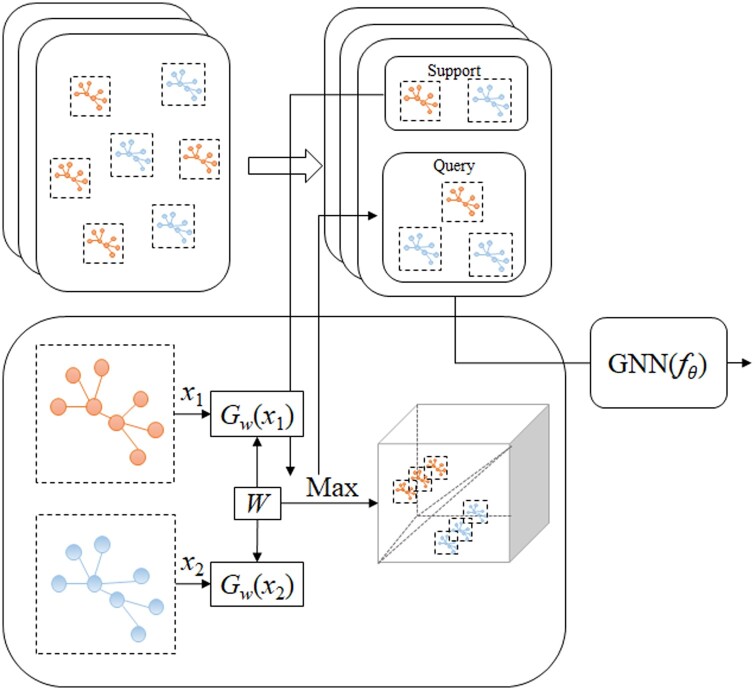
04 / Experimental setup
Table 1 lists Tox21 8,014 compounds (9/3 train/test tasks), SIDER 1,427 (21/6), MUV 93,127 (12/5), and ToxCast 8,615 (450/167). Tox21/SIDER/MUV use established task splits; ToxCast tasks are randomly partitioned. Table 3 reports query-set ROC-AUC across ten seeds, comparing ten baseline methods whose values are cited from prior work.
Published article · 2024 · Table 3 · Source ↗
05 / Results
10-shot AUC exceeds Pre-PAR on all four datasets; 1-shot results trail Pre-PAR on Tox21 and SIDER.
10-shot AUC (%) · mean ± SD, 10 runs · Published article · 2024 · Table 3 · Data source ↗
Scale: 0 → 100
| Condition | Metric / series | Reported value |
|---|---|---|
| Tox21 | 10-shot AUC (%) · mean ± SD, 10 runs | 85.93 ± 0.10% |
| SIDER | 10-shot AUC (%) · mean ± SD, 10 runs | 79.08 ± 0.14% |
| MUV | 10-shot AUC (%) · mean ± SD, 10 runs | 72.96 ± 1.18% |
| ToxCast | 10-shot AUC (%) · mean ± SD, 10 runs | 76.39 ± 1.52% |
Values refer to the stated version and experimental conditions; different metrics do not form a common ranking.
ROC-AUC %, mean ± SD across 10 seeds; Pre-PAR values cited by the paper.
Swipe horizontally, or focus and use arrow keys to see all columns →
| Dataset | Pre-PAR 10-shot | MolFeSCue 10-shot | Pre-PAR 1-shot | MolFeSCue 1-shot |
|---|---|---|---|---|
| Tox21 | 84.93 ± 0.11 | 85.93 ± 0.10 | 83.01 ± 0.09 | 82.05 ± 0.11 |
| SIDER | 78.08 ± 0.16 | 79.08 ± 0.14 | 74.46 ± 0.29 | 73.13 ± 0.56 |
| MUV | 69.96 ± 1.37 | 72.96 ± 1.18 | 66.94 ± 1.12 | 67.32 ± 1.08 |
| ToxCast | 75.12 ± 0.84 | 76.39 ± 1.52 | 73.63 ± 1.00 | 74.82 ± 1.39 |
Published article · Table 3 · Primary source ↗
06 / Ablation & limitations
Figures 3–4 remove pretrained initialization, contrastive loss or its dynamic schedule. The SIDER value in Figure 3 prose differs from Table 3, so it is not combined with the main comparison. Task transfer and ROC-AUC on imbalanced data do not establish prospective screening yield.
Improvements depend on the support size and dataset; the model does not lead every 1-shot comparison.
07 / My contribution
First author.
08 / Paper & code
Cite this research
MolFeSCue: enhancing molecular property prediction in data-limited and imbalanced contexts using few-shot and contrastive learning. Bioinformatics · 40(4), btae118, 2024. https://academic.oup.com/bioinformatics/article/40/4/btae118/7616990