01 / Research question
How can a chemical drawing become a machine-readable molecular graph without losing local chemical details?
02 / Innovation
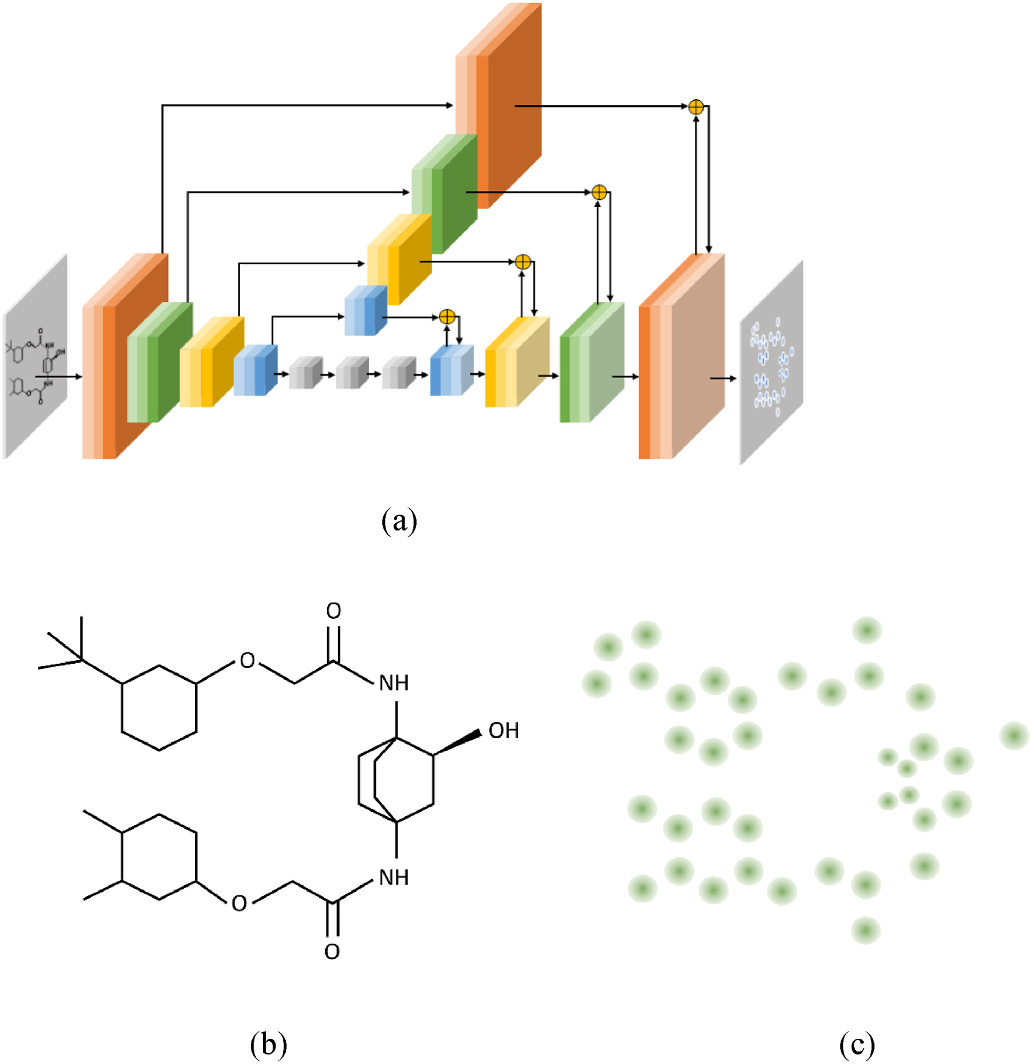
Recover molecular topology and integrate local information, including noncanonical drawings and abbreviated atom groups. The public pipeline outputs a structured representation such as SMILES.
03 / Mechanism
OCMR recovers molecular topology and resolves local atom-group details, including abbreviations, from structure drawings. The public Docker implementation exposes image-to-SMILES inference alongside MolVec, OSRA and Imago.
04 / Experimental setup
Public benchmarks are CLEF, JPO, UOB and USPTO. SMI evaluates equality of canonical isomeric SMILES after retaining the longest disconnected fragment. The evaluator compares all four recognition systems; training-set size and held-out counts are unavailable in the README.
Public repository README · benchmark table · Source ↗
05 / Results
Repository SMI scores are 0.650202, 0.604444, 0.859930 and 0.746284 respectively. These are implementation-reported values, separate from the final journal tables.
Repository-reported SMI (0–1) · Public repository README · benchmark table · Data source ↗
Scale: 0 → 1
| Condition | Metric / series | Reported value |
|---|---|---|
| CLEF | Repository-reported SMI (0–1) | 0.650202 |
| JPO | Repository-reported SMI (0–1) | 0.604444 |
| UOB | Repository-reported SMI (0–1) | 0.85993 |
| USPTO | Repository-reported SMI (0–1) | 0.746284 |
Values refer to the stated version and experimental conditions; different metrics do not form a common ranking.
SMI exact-match fraction, repository README; no internal PATENT cases included.
Swipe horizontally, or focus and use arrow keys to see all columns →
| Dataset | OCMR SMI |
|---|---|
| CLEF | 0.650202 |
| JPO | 0.604444 |
| UOB | 0.859930 |
| USPTO | 0.746284 |
README benchmark table; evaluator_benchmarks.py lines 117–146 · Primary source ↗
06 / Ablation & limitations
Abbreviations, unusual drawing styles and stereochemistry remain important error modes. Fragment normalization can discard disconnected components. The README calls its second metric Tanimoto, but the evaluator computes Dice similarity on radius-3 Morgan fingerprints; that column is therefore not plotted here. A journal ablation table remains unavailable; the original Figure 1 is reproduced under the coauthor’s retained reuse rights.
High fingerprint similarity does not guarantee an identical decoded molecule. Chemical validity and structure identity need separate checks.
07 / My contribution
Second listed author on the published article.
08 / Paper & code
Cite this research
OCMR: A comprehensive framework for optical chemical molecular recognition. Computers in Biology and Medicine · 163, 107187, 2023. https://www.sciencedirect.com/science/article/pii/S0010482523006522