01 / Research question
Electronic-health-record representations should support useful predictions while addressing differences in fairness across groups.
02 / Innovation
Learn fair representations with heterogeneous graph attention and adversarial training.
03 / Mechanism
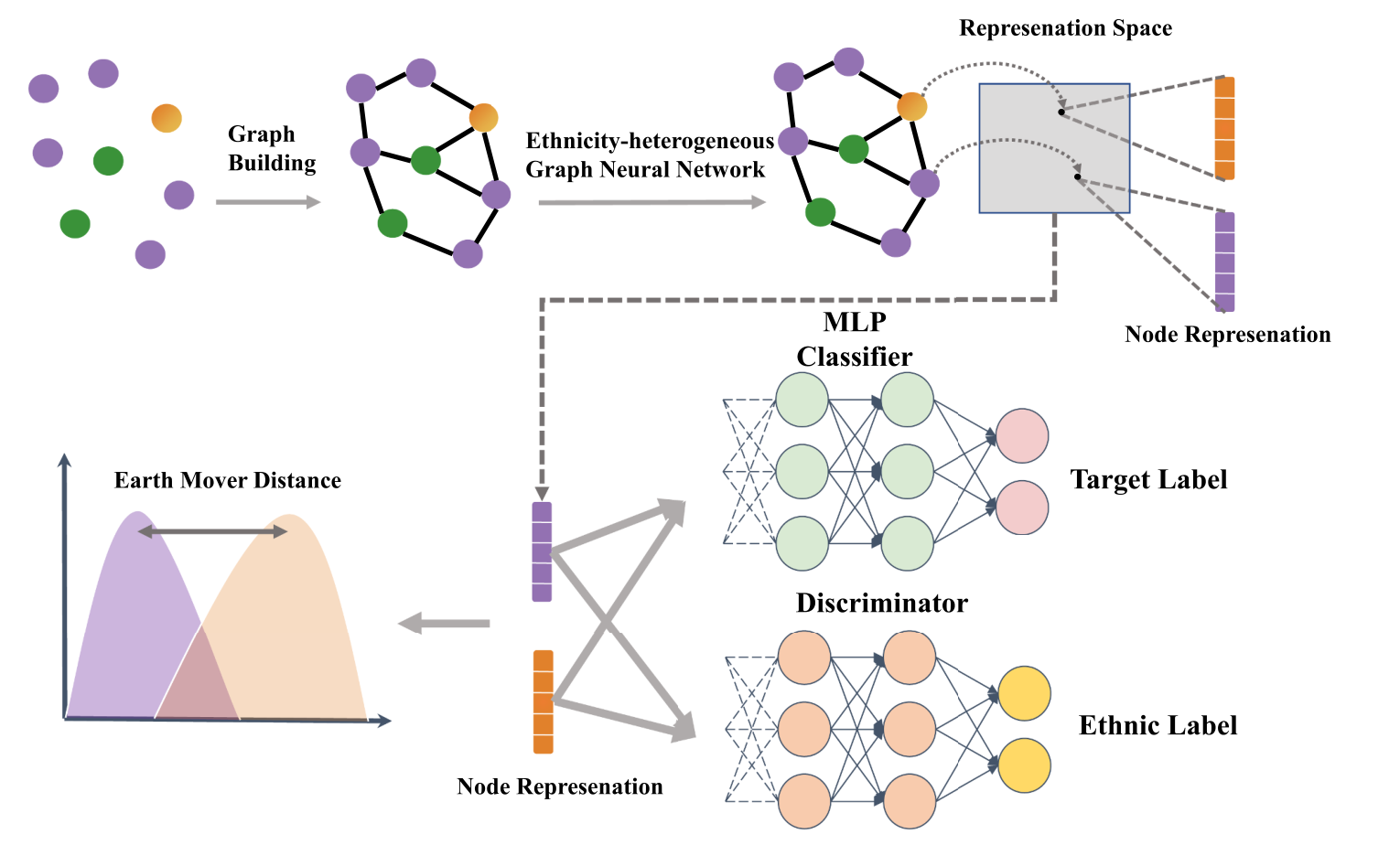
FairCare learns EHR representations with a heterogeneous graph neural network and attention. Adversarial training targets ethnicity-related fairness while retaining prognostic information. The reported framework jointly evaluates prognosis and group fairness.
04 / Experimental setup
MIMIC-III mortality and decompensation benchmarks, using the published preprocessing protocol. Prediction quality and ethnicity-related fairness are evaluated together.
Final article · 2024 · Abstract · Source ↗
05 / Results
The final abstract reports AUROC 0.9021 for mortality and 0.9217 for decompensation.
MIMIC-III AUROC (0–1) · final abstract · Final article · 2024 · Abstract · Data source ↗
Scale: 0 → 1
| Condition | Metric / series | Reported value |
|---|---|---|
| Mortality AUROC | MIMIC-III AUROC (0–1) · final abstract | 0.9021 |
| Decompensation AUROC | MIMIC-III AUROC (0–1) · final abstract | 0.9217 |
Values refer to the stated version and experimental conditions; different metrics do not form a common ranking.
06 / Ablation & limitations
Fairness depends on the population, group definitions and metric; retrospective prediction does not establish prospective clinical benefit. Exact cohort sizes, split details or complete comparison tables not available in the source inspected here are not inferred.
These are reported research evaluations, not a claim of prospective clinical benefit or live clinical deployment.
07 / My contribution
Second author; conceptualization, data curation, formal analysis, methodology, software, validation, visualization and original drafting.
08 / Paper & code
Cite this research
FairCare: Adversarial training of a heterogeneous graph neural network with attention mechanism to learn fair representations of electronic health records. Information Processing & Management · 61(3), 103682, 2024. https://doi.org/10.1016/j.ipm.2024.103682