01 / Research question
Small peptide changes can produce large antimicrobial-activity changes. Ordinary splits may obscure this activity-cliff challenge.
02 / Innovation
Quantitatively define activity cliffs in antimicrobial peptides and benchmark models with dedicated evaluation splits.
03 / Mechanism
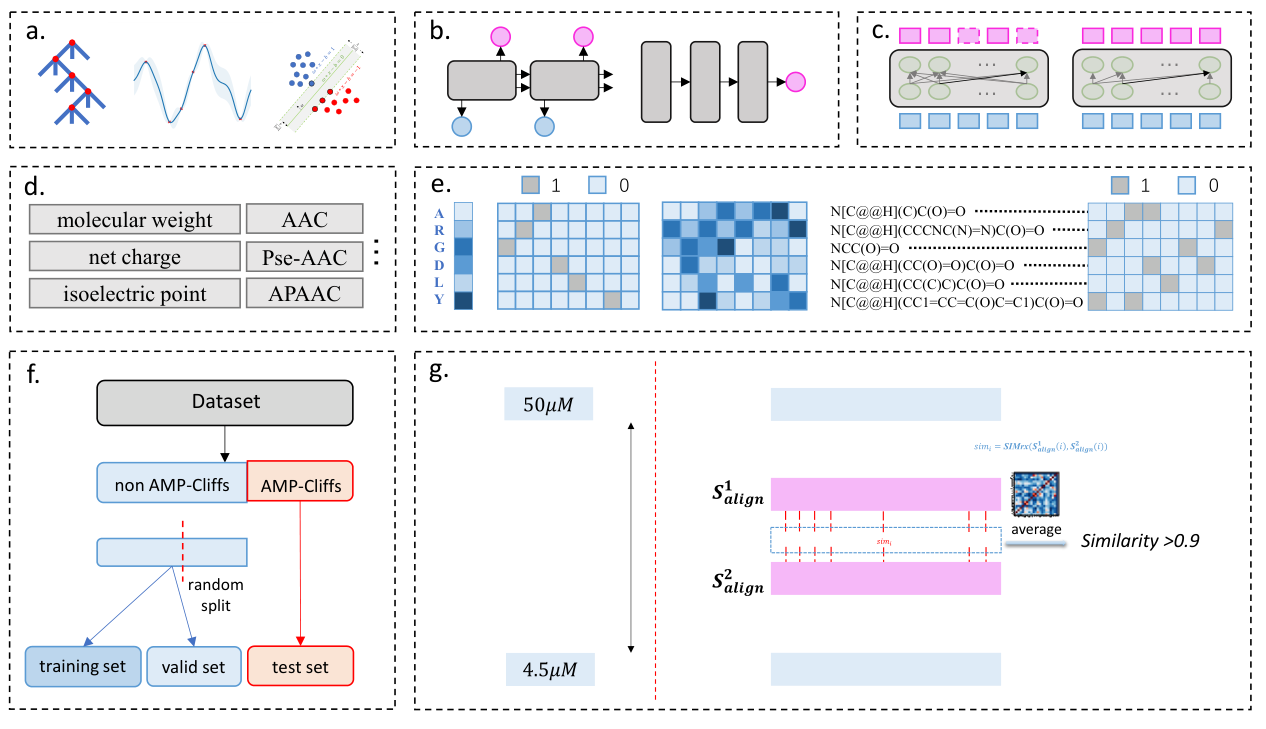
AMPCliff compares locally aligned peptides using normalized BLOSUM62 similarity ≥0.9 and MIC changes ≥2-fold. Thresholds from 2–5-fold define cliff-aware evaluation sets, rather than a new predictive architecture.
04 / Experimental setup
The v2 benchmark filters public GRAMPA measurements, removes cysteine-containing peptides, consolidates repeat MICs by geometric mean and retains 2,758 S. aureus peptides of length 7–25. Stratified 4:1 random splitting is compared with AC splitting. Baselines span conventional regressors, neural networks, ESM2 and ProGen2.
Author manuscript v2 · 3 November 2024 · Figures 5–6 · Source ↗
05 / Results
The v2 abstract reports 33-layer ESM2 Spearman 0.4669. Figures 5–6 show that ranking, regression error and top-50 recall respond differently to cliff thresholds.
06 / Ablation & limitations
Cliff pairs are sensitive to measurement noise, similarity definition and activity threshold. Random splits can overstate global correlation, while recall can behave differently at larger thresholds. Cysteine removal and the focus on canonical short peptides limit transfer to disulfide-rich, modified or longer peptides. This benchmark diagnoses failure rather than solving cliffs.
The reported correlation is specific to its benchmark and metric, not a high-accuracy therapeutic-design claim. Online publication in 2025 and the 2026 volume describe one paper.
07 / My contribution
Co-corresponding author.
08 / Paper & code
Cite this research
AMPCliff: quantitative definition and benchmarking of activity cliffs in antimicrobial peptides. Journal of Advanced Research · 80, 287–300, 2026. https://doi.org/10.1016/j.jare.2025.04.046